



DESCRIPTION
Note: microK has now been superseded by the microK² precision thermometry bridge.
The original microK remains fully supported for service and calibration.
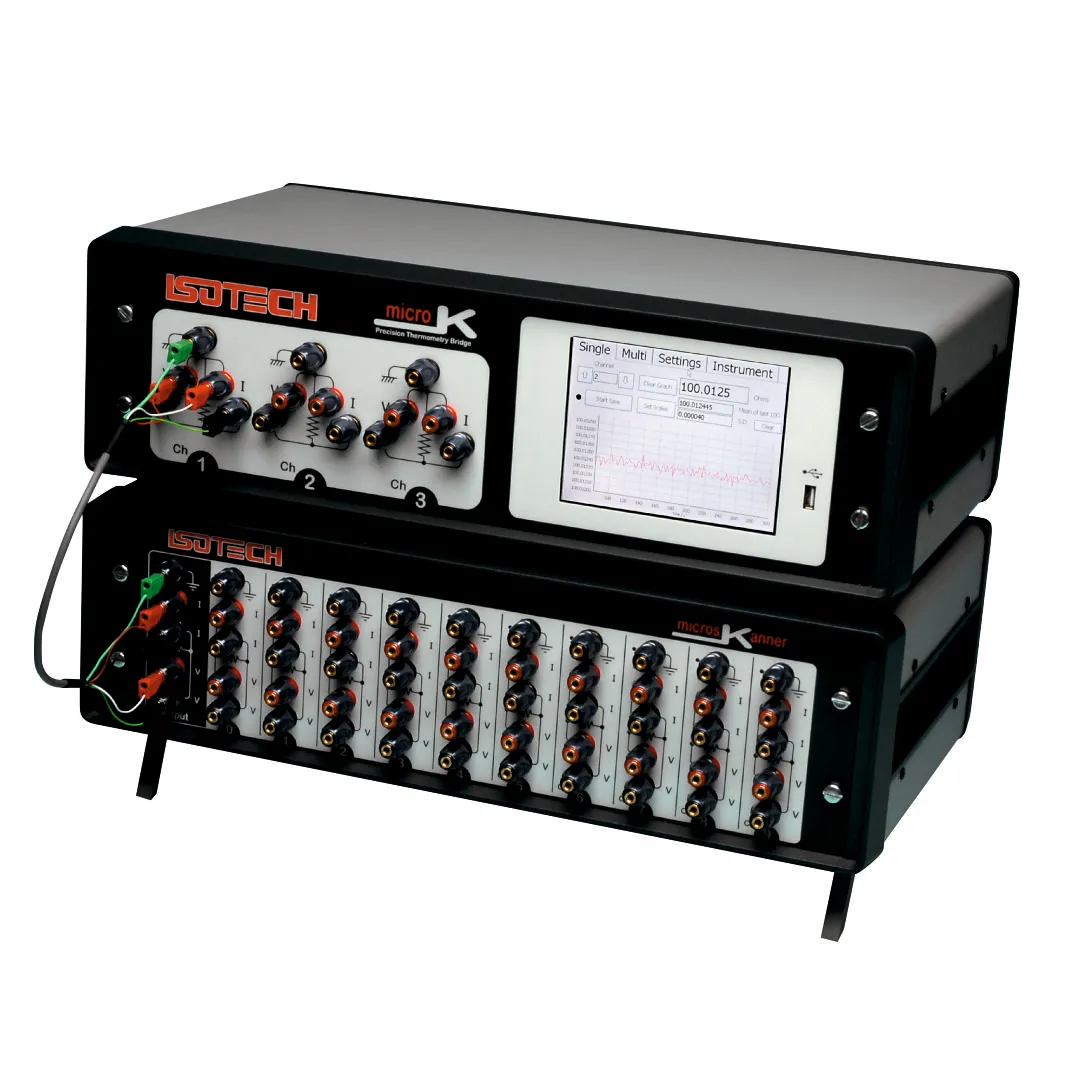
The microK 70 and 125 models are designed for the Primary Temperature Laboratories whilst the microK 250 and 500 models were designed for the Secondary Laboratory as well as a wide range of high accuracy industrial and scientific calibration applications. The instruments use a completely new measurement technique to achieve accuracies better than 0.02 parts per million (ppm). In April 2017 Isotech won a Queen’s Award for Enterprise in the Innovation category for the co-development of the microK, read more in our news section.
When used with a 0°C cold junction reference unit, or by measuring the junction temperature with a PRT on another channel the instrument is capable of low uncertainty precision thermocouple measurements, with a voltage uncertainty of just 0.25μV, equivalent to 0.01°C with a Platinum / Gold Thermocouple at 1000°C.
The microK range consists of four instruments offering a choice of measurement accuracy of 0.07 to 0.5ppm over the whole range, equivalent to 0.07mK to 0.5mK over the whole range of an SPRT with a Ro >2.5Ω. Better at unity ratio.
The instruments in the microK range offer performance characteristics and features which are simply not available elsewhere. Comparable instruments available internationally do not achieve the same accuracy or stability (zero drift characteristics with SPRT measurements are not obtainable in any other instrument), other instruments do not support the same variety of sensors, and offer considerably less operational features. The microK family uses solid state construction with no potentiometers or relays which ensures long term reliability and low cost of ownership, a feature of growing international importance.
SPECIFICATION
| Parameter | microK 70 | microK 125 | microK 250 | microK 500 |
|---|---|---|---|---|
| Accuracy Whole Range (SPRT Ro ≥ 2.5Ω) [1] | 0.07ppm | 0.125ppm | 0.25ppm | 0.5ppm |
| Accuracy Ratio 0.95 to 1.05 [2] | 0.017ppm | 0.03ppm | 0.06ppm | 0.125ppm |
| Equivalent Temperature Accuracy [2] | 0.017mK | 0.03mK | 0.06mK | 0.125mK |
| Resolution | 0.001mK | 0.001mK | 0.01mK | 0.01mK |
| Ratio Resolution | 1 ppb | 1 ppb | 10 ppb | 10 ppb |
| Resolution Voltage | 10nV | 10nV | 10nV | 10nV |
| Stability | 0ppm/yr [3] | 0ppm/yr [3] | 0ppm/yr [3] | 0ppm/yr [3] |
| TC (resistance ratio) [4] | 0ppm/ ° C [3] | 0ppm/ °C [3] | 0ppm/ °C [3] | 0ppm/ °C [3] |
| Resistance Range | 0-100 kΩ | 0-100 kΩ | 0-500kΩ | 0-500kΩ |
| Voltage Range (Thermocouple) | ±125mV | ±125mV | ±125mV | ±125mV |
| Internal Resistance Standards | 25, 100, 400Ω | 25, 100, 400Ω | 1, 10, 25, 100, 400Ω | 1, 10, 25, 100, 400Ω |
| Internal Standard | TCR <0.5ppm/°C | ² | 1, 10Ω <0.6ppm/°C <5ppm/year | “ |
| Resistor Stability | Annual Stability <2ppm/year | “ | 25, 100, 400 <0.3ppm/°C <5ppm/year | “ |
| Thermistor Performance | 0-10K 4ppm 10-40K 15ppm 40-100K 35ppm |
0-10K 4ppm 10-40K 15ppm 40-100K 35ppm |
0-10K 1ppm 10-40K 3ppm 40-100K 10ppm 100-500K 40ppm |
0-10K 1ppm 10-40K 3ppm 40-100K 10ppm 100-500K 40ppm |
| Interfaces | RS232, GPIB & USB & Ethernet | “ | RS232, GPIB, USB | “ |
| Power | 25W maximum, 1.5A (RMS) maximum | “ | 20W maximum, 1.5A (RMS) maximum | “ |
| Weight | 13.3kg | 13.3kg | 12.4kg | 12.4kg |
VIDEOS
PLAYLIST
DOWNLOADS
microK Precision Thermometry Bridge
-200°C to 1800°C
Note: These microK models have been superseded by the microK² platform.
The microK 70 and 125 models are designed for the Primary Temperature Laboratories whilst the microK 250 and 500 models were designed for the Secondary Laboratory as well as a wide range of high accuracy industrial and scientific calibration applications.- Ratio Accuracy to <0.02ppm (20ppb) with Zero Drift
- SPRTs, PRTs, RTDs, Thermistors and Thermocouples
- Reliable 21st Century 100% Solid State Design
We are online and ready to chat to you if you need any advice and support, or if you prefer you can fill out the form below.
Or call +44 01704 543830
Related products
-
 Read more
Temperature Controlled Fixed Resistors
Nominal Temperature Coefficient of Resistance: +0.02ppm/°C (with temperature control on) 18 to 25°C
Model 456. By temperature controlling an otherwise very stable resistor a performance close to the very best available World-wide can be achieved at a surprisingly low price.
-
 Read more
913-HC microsKanner
-200°C to 1800°C
Fully compatible with all microK and microK² bridges, with increased sensor current capability (up to 14.2 mA when used with microK²) and updated styling to match the latest design.
-
 Read more
microK Gold
-200°C to 1800°C
Note: This microK model has been superseded by the microK² platform.
Best performance, documented, guaranteed with an unmatched satisfaction promise. -
 Read more
microK Channel Expander
-200°C to 1800°C
The microsKanner can be used with any member of the microK family to add further channels, up to a maximum of 90 expansion channels.


