
What is a “bridge”?
Those disseminating the ITS-90 Temperature Scale rely on the ITS-90 Fixed Points and SPRTs as the interpolation device. These devices are commonly calibrated, a thermometry bridge will be used to measure the SPRT by comparing the resistance of SPRT to a known reference resistor.
Thermometry Bridges, also known as ratio bridges, resistance bridges., AC Bridges, DC Bridges or even just a bridge can have claimed accuracies down to several parts per billion.
How can you trust a bridge?
It is very difficult to calibrate a bridge to an uncertainty of <20 ppb; especially over it’s a whole measuring range. Relying on performance by design may have been acceptable in the past but not today. In the past simple complement and reciprocal tests were used but this does not give a enough data to verify performance over the whole range – and research has shown something like 20% of bridges perform outside manufacturers specifications.

The Answer – the RBC
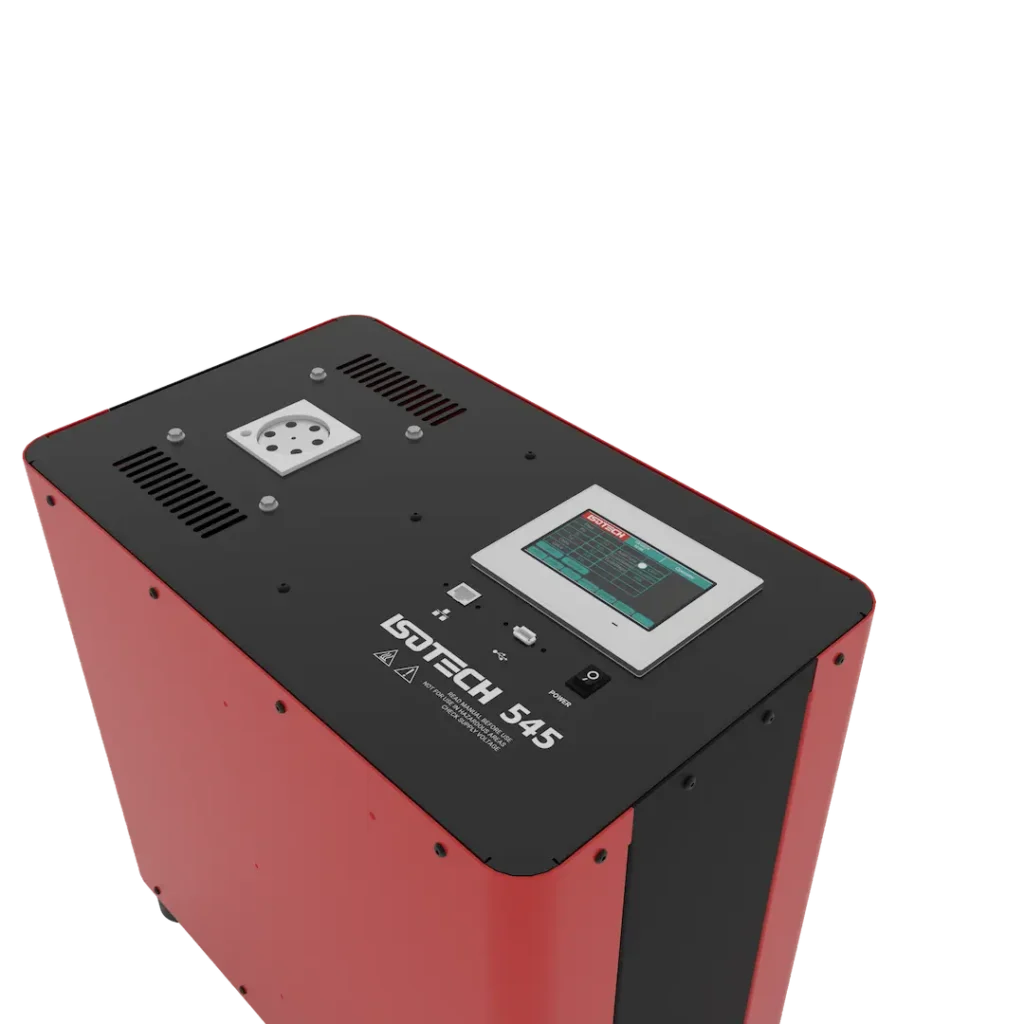
The RBC or Ratio Bridge Calibrator was designed by D. R. White, and Isotech have an exclusive license to manufacture and sell the RBC globally.
Features
- Calibrate ac and dc thermometry bridges
- High accuracy – better than 0.01 ppm at 100 Ohms
- Patented design licensed from IRL
- Windows application for full analysis and reporting
RBC Operating Principles
The problem: Temperature measurement is one of the most demanding applications of resistance measurement. It requires the measurement of resistance ratios to accuracies of 0.1ppm or better. While dc resistance standards are sometimes available at this level, ac resistance standards are generally not. So how can we show our bridges are accurate at this level, and that our resistance and temperature measurements are traceable?
The Bridge Linearity Check
One simple method for checking a resistance bridge is to measure a pair of resistors separately, and then measure the two in series. Ideally the series measurement should equal the sum of the two individual measurements. If not, then the measurements give us a bit of information about the errors in the bridge readings. Note that we do not need to know the values of the resistors to make this test work.
The Bridge Combinatorial Method
The RBC exploits the same principles as the linearity and complement check. It uses a network of four stable four terminal resistors that can be connected in 35 different series and parallel combinations. By measuring each RBC combination in the two different ways (as with the complement check) up to 70 different measurements can be made. Since the RBC has just four unknown resistance values, we have up to 66 independent measurements containing information about the errors in the bridge readings. The combinatorial calibration method is particularly powerful because it is not necessary to know the actual values of the four resistors, or their frequency dependence. This means we can calibrate any ac or dc bridge to any accuracy, so long as the various resistance combinations are accurate.
The RBC Patent
The patented RBC Calibrators are a result of research carried out by Rod White at the Measurement Standards Laboratory of New Zealand, which operates within Industrial Research Ltd (IRL). Isothermal Technology Ltd has an exclusive licence from IRL to develop, sell and produce the RBC.
Introductory Video to Bridge Calibration using the RBC


Learn More
Papers
Characterisation of a selection of AC and DC resistance bridges for standard platinum resistance thermometry NPL: J.V. Pearce, J. Gray, R.I. Veltcheva
A Method for Calibrating Resistance Thermometry Bridges, White D. R. NIST: Michal Chojnacky, Jesse Kosior, Luis Chaves-Santacruz, Greg Strouse
Resources




We are here to help you
Making sure you get the product you need


