
Using water and gallium fixed points to monitor thermometer stability between calibrations
If you use a standard platinum resistance thermometer (SPRT), or a good quality industrial platinum resistance thermometer, its calibration provides the basis for your measurements. It establishes the thermometer’s characteristics at the time of calibration. Regular checks help you assess whether those characteristics have changed in use.
An accredited laboratory can calibrate a thermometer with a stated uncertainty appropriate to the work. Between calibrations, however, you need a way to monitor its stability. A water triple point cell and a gallium cell provide two useful checks that can be made in your own laboratory.

The gap between calibrations
Handling in transit, mechanical shock, thermal cycling, contamination and strain in the platinum element can all change a thermometer’s resistance.
If a change is only discovered at the next calibration, you may need to review measurements made since the previous one. Depending on the application, this could mean re-testing batches, revisiting reported results or notifying customers. The difficulty is establishing when the change occurred and which measurements it affected.
Regular intermediate checks help narrow that period and provide a record on which to base any investigation.
ISO/IEC 17025:2017 addresses this through its requirements for intermediate checks, where needed to maintain confidence in equipment performance (clause 6.4.10), and for monitoring the validity of results (clause 7.7.1). For reference platinum resistance thermometers, checks at the water triple point and gallium point can contribute to meeting these requirements.
Resistance and resistance ratios
RTPW
The thermometer’s resistance at the water triple point, 0.01 °C.
This is the reference used to calculate SPRT resistance ratios.
W(t90)
The resistance ratio
R(t90)
/ RTPW.
By definition, W = 1 at the water triple point.
W(Ga)
The resistance ratio at the gallium melting point:
R(29.7646 °C) /
RTPW.
W(Ga) ≥ 1.11807 is one of the ITS-90 qualification criteria for an SPRT.

Why use water and gallium
The water triple point is a defining fixed point of ITS-90. It provides the reference resistance used to calculate SPRT resistance ratios, making it central to both calibration and subsequent stability checks.
The gallium melting point, 29.7646 °C, provides a second check near room temperature. This is useful for laboratories working in healthcare, pharmaceuticals, food and environmental measurement. High purity gallium produces a long, flat melting plateau and is relatively straightforward to realise with suitable apparatus.
Monitoring RTPW
Measuring resistance at the water triple point is one of the most useful checks on a platinum resistance thermometer. With a suitable cell, measuring system and careful technique, uncertainties below 0.001 °C can be achieved.
A practical routine is to:
- Measure RTPW when the thermometer returns from calibration. Compare it with the certificate value to check for a change in transit, and record it as the baseline for subsequent checks.
- Repeat the measurement at defined intervals and after events that could have affected the thermometer, such as a drop, rapid thermal cycling or a change of application.
- Plot the results on a control chart, with warning and action limits based on the uncertainty of the checks and the requirements of your measurements.
- Where your calibration procedure uses an updated RTPW, enter the accepted value into the bridge or thermometry instrument. Investigate significant changes before updating it.
| Property | Water Triple Point | Gallium Melting Point |
|---|---|---|
| ITS-90 temperature | 0.01 °C | 29.7646 °C |
| Status | Defining fixed point and reference for SPRT resistance ratios | Defining fixed point near room temperature |
| Realisation | Ice mantle, prepared and annealed before use | Melt plateau |
| Typical purity | Distilled, of specified isotopic composition | > 99.99999 % (7N) |
| Achievable uncertainty | Tens of microkelvin with a good cell and careful practice | To below 0.1 mK; day-to-day reproducibility of ±0.000025 °C |
| Hydrostatic head | −0.73 mK per metre | −1.2 mK per metre |
| Practical strength | Provides RTPW for resistance ratios and stability checks | Provides a sensitive check of W(Ga) near room temperature |
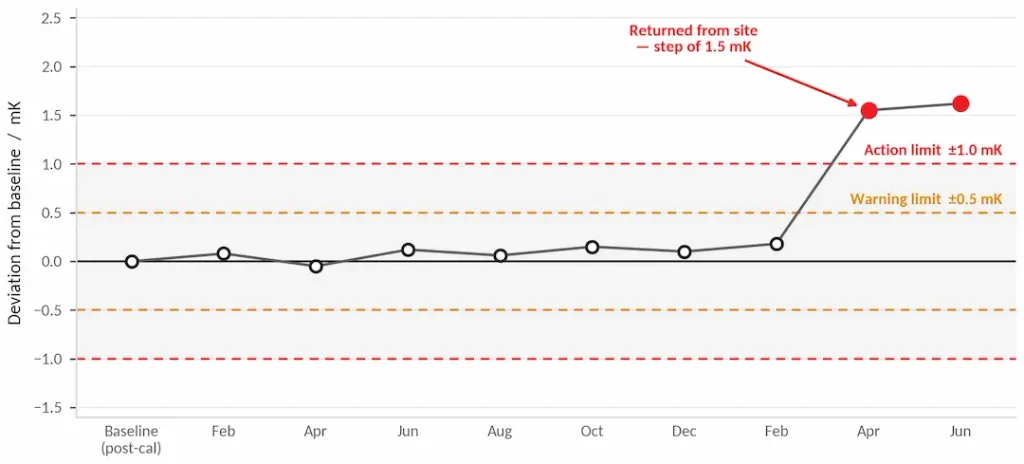
A series of readings shows whether the thermometer is stable, drifting or has changed abruptly. Keeping this record makes it easier to assess performance and explain the basis of decisions about continued use or recalibration.
Monitoring W(Ga)
A gallium cell allows you to check the resistance ratio as well as the resistance at the water triple point:
W(Ga) = R(29.7646 °C) ÷ RTPW
ITS-90 includes W(29.7646 °C) ≥ 1.11807 as one of the qualification criteria for an SPRT, with an alternative criterion at the mercury triple point. The ratio gives an indication of the purity and strain-free condition of the platinum element. Measuring W(Ga) allows you to check this criterion and compare the result with the thermometer’s calibration.
Considering RTPW and W(Ga) together can also help with diagnosis. Strain can increase resistance across the temperature range by approximately the same amount. This raises RTPW and reduces W(Ga) towards unity:
- An increase in RTPW accompanied by a fall in W(Ga) can indicate strain. Annealing may help, but the cause should be investigated and any treatment should follow the procedure appropriate to the thermometer.
- Stable values of both support continued use, subject to the laboratory’s acceptance limits and other checks required for the application.
Comparing with the W table
An SPRT calibration may include a W table giving the ratio W(t90) = R(t90) / RTPW across the calibrated range, together with the ITS-90 deviation function coefficients. Comparing a measured W(Ga) with the value calculated from those coefficients provides a sensitive check near room temperature.
Icarus, used in Isotech’s accredited laboratories to produce SPRT certificates, generates W tables from calibration coefficients. Our web SPRT calculator also provides calculations using ITS-90 coefficients. The water and gallium checks can help identify changes that may affect measurements elsewhere in the calibrated range. They do not, on their own, establish the thermometer’s error at every temperature or replace calibration at the other required fixed points.
These two checks are convenient to make near room temperature. Their results should be assessed alongside the thermometer’s history, operating range and required uncertainty.
Getting the realisation right
Reliable checks depend on the measurement procedure as well as the cells. The main points to consider are:
- Immersion. The sensor must be sufficiently immersed in the re-entrant well to minimise heat flow along the stem and reach thermal equilibrium with the cell.
- Self-heating. Measure at two suitable currents, commonly 1 mA and √2 mA for an SPRT, and extrapolate to zero power. Self-heating depends on both the thermometer and the surrounding medium.
- Ice mantle preparation. A water triple point cell needs a properly formed and annealed mantle, with time to settle before use. An ice mantle maker can make preparation easier and more consistent.
- Plateau management. Gallium is used on the melting plateau. Follow the apparatus procedure for establishing the solid–liquid interfaces and allow sufficient time for equilibrium before taking readings.
- Cell verification. Sealed cells are stable standards, but their performance still needs periodic verification. This may involve comparison with another cell, an interlaboratory comparison or accredited calibration.

Costs and recalibration intervals
For a laboratory with several SPRTs, in-house fixed-point checks may reduce external calibration and transport costs. A consistent record of stability can support a review of recalibration intervals. The likely saving depends on the number of thermometers, their use, the required uncertainties and the cost of maintaining the checking facilities.
Any extension to a recalibration interval should be documented and supported by performance data and an assessment of risk. For accredited work, it should also be consistent with the laboratory’s quality procedures and applicable accreditation requirements.
Routine RTPW and W(Ga) measurements can help you:
- Review recalibration intervals using recorded performance data.
- Assess thermometer stability against defined acceptance limits.
- Detect changes between scheduled calibrations.
- Reduce transport and handling where longer calibration intervals are justified.
- Provide evidence to support the relevant ISO/IEC 17025 requirements.
- Check the ITS-90 gallium qualification criterion and compare W(Ga) with the calibration value.
Putting the checks into practice
A calibration certificate and a record of intermediate checks serve different purposes. Together, they provide a stronger basis for deciding whether a thermometer remains suitable for its work.
Water and gallium cells, used with a suitable measuring system and a consistent procedure, make these checks practical within the laboratory. The value comes from recording the results, reviewing trends and acting when a limit is exceeded.
If you are considering fixed-point checks, or would like help with your existing procedure, we can advise on the cells, apparatus and measurement techniques appropriate to your application.
Explore our products


Get In Touch


