
In everyday life, a thousandth of a degree may sound irrelevant. The answer to why it matters begins in national standards laboratories, but it does not end there.

We do not set thermostats to that resolution, cook by it, or notice it in the weather. Even in many industrial settings, a tenth of a degree is more than adequate. Yet there are measurement contexts in which 0.001 °C, one millikelvin, is not a refinement but a requirement. Understanding why begins with the question of where traceable temperature measurement starts, and who is responsible for maintaining it.
Where the Scale Begins
Temperature measurement does not start with a sensor in a process or a thermometer in a laboratory. It starts with national standards bodies, the National Metrology Institutes (NMIs), whose work underpins every temperature measurement made anywhere in the world.
The BIPM framework currently includes 65 Member States and 35 Associate States and Economies, forming the international basis for mutual recognition of national measurement standards. Their capabilities vary. Some realise ITS-90, the International Temperature Scale of 1990, from first principles, using fixed-point cells and primary resistance bridges. Others maintain and disseminate the scale through calibration services, drawing on standards traceable to the primary level. Together they form a global network that keeps national temperature measurements coherent and mutually comparable.
At the primary level, a significant number of NMIs worldwide realise ITS-90 from its physical foundations. These include laboratories across North America, Europe, Asia and Australasia, among them NIST, NPL, PTB, NRC, NMIJ, LNE, INRIM, VNIIM, NIM, KRISS and RISE, among others. Their measurement to 0.001 °C or better is not an excess of caution. It is a necessity for maintaining a scale that the rest of the world can trace back to something fixed and reproducible.
Fixed Points and the Physical Foundations of ITS-90

ITS-90 defines temperature through fixed physical references: phenomena that occur at precisely reproducible conditions, regardless of the instrument used to observe them. These include the triple point of water, where ice, liquid and vapour coexist at exactly 0.01 °C; the melting point of gallium; and the freezing points of pure metals such as indium, tin, zinc, aluminium and silver. At cryogenic temperatures, the triple points of certain gases provide further defining references.
Each fixed point is a realisation of temperature in the most fundamental sense. An NMI uses these references to calibrate Standard Platinum Resistance Thermometers (SPRTs), instruments of exceptional stability whose electrical resistance changes in a precisely characterised way with temperature. By measuring that resistance using purpose-built resistance bridges and stable reference resistors, a laboratory can assign temperature values that trace directly to the physical constants of ITS-90.
This chain, from fixed point to SPRT to resistance measurement to the wider world, is the foundation on which all other temperature measurement rests. Every laboratory, every sensor, every process that claims traceability depends on the integrity of this chain at its source.
International Comparisons and the Coherence of the Scale
Because different NMIs realise ITS-90 independently, their results must periodically be compared. The Consultative Committee for Thermometry (CCT), operating under the BIPM, the International Bureau of Weights and Measures, organises key comparisons that test the agreement between national realisations of the scale.
The CCT-K7 key comparison of water triple point cells is one such programme. Cells maintained by NMIs across the world were compared with each other, and the published results demonstrated agreement at the level of tens of microkelvin, a small fraction of one millikelvin. The significance of this is not academic. If national realisations of the scale diverged by even a few millikelvin, every calibration laboratory, every process sensor, every clinical thermometer tracing to them would carry that inconsistency downstream. The CCT comparison programmes exist to prevent that. Results are publicly available through the BIPM Key Comparison Database, and the CCT-K7 programme is published as Stock et al. (2006), Metrologia, 43, 03001.
Documented Use at the Primary Level
Published literature from primary NMIs records programmes in which Isotech equipment has formed part of the measurement infrastructure. Each example below links to the relevant publicly available source, allowing readers to verify the claims directly.
NIST: Optical Lattice Clock Sensor Calibration
A clear example appears in NISTIR 8046, Calibration of Thin-Film Platinum Sensors for Use in the JILA Sr II Clock. In this work, NIST calibrated platinum resistance sensors for use in an optical lattice clock vacuum chamber. The report states that SPRT and test sensor resistances were measured using an Isotech microK 70 precision thermometry bridge, with resistance measurements referenced to a calibrated 100 ohm Tinsley standard resistor traceable through NIST’s Quantum Measurement Division to the Quantum Hall Ohm.
Read the full report: NISTIR 8046 (https://doi.org/10.6028/NIST.IR.8046)
NPL: SPRT Non-Uniqueness Characterisation
Published research from NPL into Type 3 non-uniqueness in Standard Platinum Resistance Thermometers, covering the range 83 K to 353 K, reports the use of an Isotech microK Model 70 resistance bridge for the high-stability comparison measurements the work required. Non-uniqueness characterisation at this level demands resistance measurement with noise and drift well below one millikelvin.
Read the full paper: Veltcheva et al. (2023), Measurement, 216, 112863 (doi.org/10.1016/j.measurement.2023.112863)
PTB and NIM: Triple Point of Water Bilateral Comparison
A bilateral comparison of triple point of water cells between NIM (China) and PTB (Germany) provides a further example. Published in Measurement: Sensors (Yan et al., 2025), the cells were maintained in an Isotech ITL-M-18233 water triple point maintenance bath while the two national laboratories compared their realisations of the defining 0.01 °C fixed point. After applying isotopic corrections, the NIM and PTB realisations agreed within 0.0005 mK, with an uncertainty of 0.03 mK (k = 1), demonstrating the level of care required in primary temperature metrology.
Read the full paper: Yan et al. (2025), Measurement: Sensors, 38, 101621 (https://doi.org/10.1016/j.measen.2024.101621)
The Same Requirement, in Different Contexts

The need for millikelvin measurement is not confined to the national laboratory. Different disciplines have arrived at the same requirement independently, following the same logic: when the signal being sought is small, the quality of the measurement must be better than the signal itself.
Deep-Ocean Climate Research

The world’s oceans absorb the majority of the excess energy trapped by greenhouse gases. Because water has a very high heat capacity and the oceans are vast, that enormous energy uptake produces temperature changes that are paradoxically subtle. Over long periods, deep-ocean warming may unfold in increments of millikelvins. Yet even these fractional changes matter, because thermal expansion across that volume translates into measurable sea-level rise.
Detecting those changes demands more than high-resolution sensors. It demands that sensors be calibrated against the same fixed-point references used by NMIs, the triple point of water and the gallium melting point, which bracket the temperature range of most ocean water. By anchoring to those physical references, researchers can distinguish a genuine environmental signal from sensor drift. The calibration framework has to be as rigorous as the science it supports.
A detailed account of how metrology-grade calibration is being applied in oceanographic and climate research is in our companion piece: Isotech in Climate and Oceanographic Research
Astronomical Spectrographs

High on remote mountain peaks, precision spectrographs are searching for planets beyond our solar system using radial velocity measurement, detecting tiny shifts in a star’s spectrum caused by the gravitational pull of an orbiting planet. For Earth-like candidates, those shifts correspond to velocity changes of a few centimetres per second. This places extraordinary demands on the instrument’s thermal environment.
In published work on the Habitable-Zone Planet Finder (HPF), the environmental control system demonstrated 0.64 mK RMS stability over 15 days at its 180 K operating temperature. Published work from instruments including HPF, NEID and iLocater records sub-millikelvin stability as both a design requirement and a demonstrated result. Any small change in temperature can alter optical paths, mechanical dimensions or detector behaviour, and what appears to be a planetary signal may instead be a thermal artefact.
The application of precision thermometry in astronomical instrumentation is explored in more detail in our companion piece: Why the Isotech microK is Found on Mountain Tops
A Pattern Worth Noting
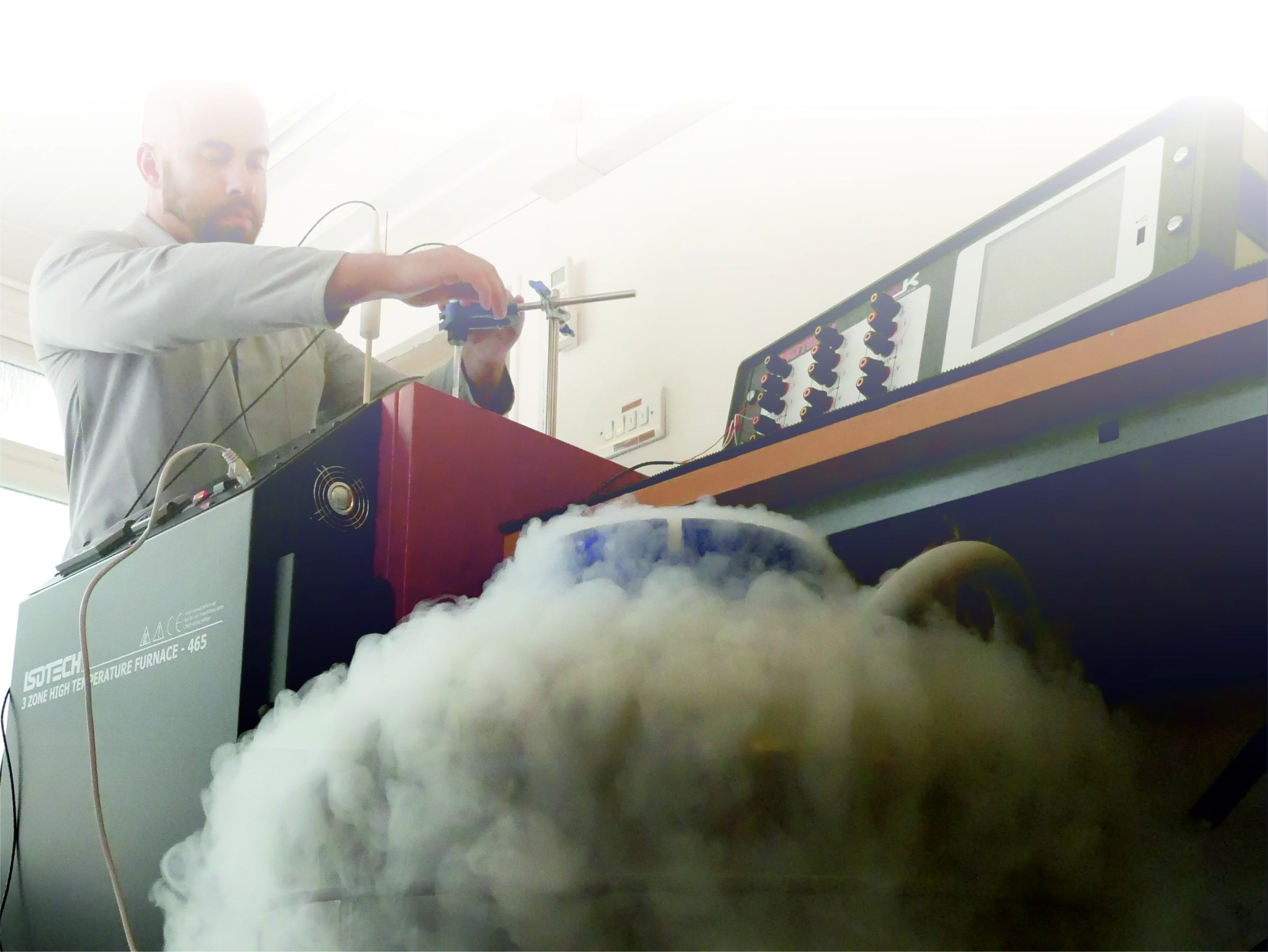
The pattern across these fields is consistent. In each case, the need for millikelvin measurement arises not from a desire to display more decimal places, but from a requirement to reduce uncertainty to a level below the signal being sought.
In a national laboratory, that signal is the agreement between independent realisations of the temperature scale. In oceanography, it is the warming of a deep ocean that changes slowly and subtly over decades. In astronomy, it is the wobble of a distant star betraying the presence of an orbiting world. The measurement principle is the same in each case. When the signal is small, the measurement infrastructure has to be better than the signal. That is why 0.001 °C is not an extravagance. It is where confidence begins to matter in a different way.
Explore Our Products


Disclaimer and Attribution
Mentions of organisations, instruments and projects are for identification and informational purposes only and do not imply endorsement or affiliation. Technical parameters reflect publicly available sources as cited and may change without notice. All trademarks are the property of their respective owners.
References
- Consultative Committee for Thermometry (CCT): https://www.bipm.org/en/committees/cc/cct
- BIPM Key Comparison Database: https://www.bipm.org/kcdb/
- BIPM Member States: https://www.bipm.org/en/cgpm/member-states
- Stock, M. et al. (2006). CCT-K7: Key comparison of water triple point cells. Metrologia, 43(1A), 03001. https://doi.org/10.1088/0026-1394/43/1A/03001
- Veltcheva, R. et al. (2023). Investigations of Type 3 non-uniqueness in standard platinum resistance thermometers between 83 K and 353 K. Measurement, 216, 112863. https://doi.org/10.1016/j.measurement.2023.112863
- Yan, X. et al. (2025). Comparison of triple point of water cells with isotopic composition between NIM and PTB. Measurement: Sensors, 38, 101621. https://doi.org/10.1016/j.measen.2024.101621
- Tew, W. L., Nicholson, T. L. and Hutson, R. B. (2015). Calibration of Thin-Film Platinum Sensors for Use in the JILA Sr II Clock. NISTIR 8046. https://doi.org/10.6028/NIST.IR.8046
- Stefánsson, G. et al. (2016). A versatile technique to enable sub-millikelvin instrument stability for precise radial velocity measurements: tests with the Habitable-Zone Planet Finder. The Astrophysical Journal, 833(2), 175. https://doi.org/10.3847/1538-4357/833/2/175
Get In Touch


