
As we enter the last few weeks of 2026, Isotech is reflecting on forty years of accredited calibration at its Southport laboratory. From its early beginnings, the laboratory has grown to serve national metrology institutes, support scientific research and train temperature metrologists from around the world.
In 1986, a newspaper reported the laboratory’s approval under the headline “Tiny lab sets the standards”. Following its application in 1985, Isotech received approval for temperature and electrical measurements, becoming, according to the report, one of only five laboratories in the country approved by the British Calibration Service for temperature measurement. Pictured showing a visitor around was Isotech founder John Tavener, who drove the laboratory’s development and contributed internationally through fixed point standards, published research and collaboration. His work advanced laboratory methods worldwide, while his commitment to reducing uncertainty and sharing practical knowledge laid the foundations for today’s capabilities.
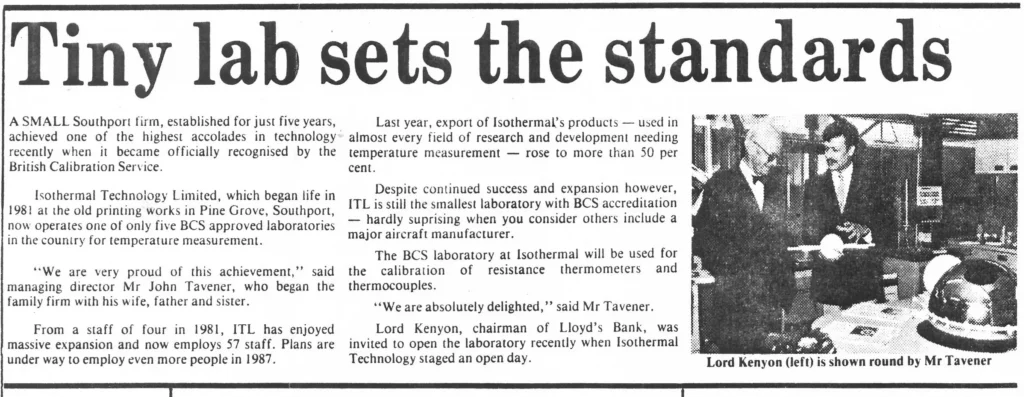
From a Small Laboratory to International Recognition
Today, the Laboratory holds UKAS accreditation number 0175 to ISO/IEC 17025:2017. Its accredited temperature calibration capabilities include uncertainties smaller than those offered by most national metrology institutes, and Isotech has the lowest uncertainties of any privately owned temperature calibration laboratory.
That capability matters to customers maintaining their own temperature standards. The uncertainty of a reference calibration contributes to the uncertainty of subsequent measurements. A laboratory with demanding requirements needs a calibration service capable of supporting them.
Isotech was the first UKAS laboratory accredited to calibrate ITS-90 fixed point cells. Alongside thermometer calibration, this allows the laboratory to assess the references used by other laboratories to realise the temperature scale.

Working with the Metrology Community
Under Laboratory Director Nick Davies, the laboratory continues to serve national metrology institutes and calibration laboratories. Its work brings together calibration, investigation of fixed point standards and the practical knowledge needed to use them.
Research involving Nick Davies examined 100 water triple point cells manufactured between 2001 and 2006, investigating agreement between cells and the influence of the water’s isotopic composition. Such investigations help explain differences that become significant at the smallest uncertainties.
Isotech’s wider development work has also drawn on collaboration with national laboratories. The original microK thermometry bridge, for example, was developed with contributions from the UK’s National Physical Laboratory.

Supporting Ocean Research and Astronomy
The reach of this temperature metrology expertise extends into research where very small changes matter. A study by researchers at Canada’s National Research Council and the Royal Netherlands Institute for Sea Research used an Isotech microK 70 in a facility for calibrating deep-ocean reference thermometers with sub-millikelvin uncertainty.
In astronomy, instruments including the Habitable-Zone Planet Finder and NEID use microK bridges to monitor the thermal stability of spectrographs searching for planets around other stars. Small temperature changes can affect the instruments and interfere with the signals astronomers are trying to measure.
These applications show why low uncertainty, stability and dependable reference measurements have value far beyond the calibration bench.

Passing on the Knowledge
Training has become another important part of Isotech’s contribution. The laboratory welcomes visiting metrologists for specialist courses, while “From Industry to ITS-90” introduces the principles and practice of temperature calibration to a wider audience. Courses are delivered in the UK and internationally, with specialist training tailored to participants’ requirements.
Investing in the Future
In 2026, Isotech made a record investment in the laboratory’s future, securing higher-purity metals for fixed point cells, bringing a distillation research project into production and expanding the team. These developments form part of a long-term plan to meet future calibration demand and the evolving needs of global temperature metrology.

Thank You
Isotech thanks the colleagues, customers and collaborators who have contributed to forty years of accredited calibration. That experience continues to support customers as they establish standards, improve their measurements and develop the skills to use them.
Find out more about our calibration services and training.
Explore our products


Get In Touch


